
Organic-based fertilisers (OBFs) as a climate change mitigation tool:
Climate change is one of the biggest challenges faced by the agricultural industry today, and our response to it will have lasting effects on the way we approach farming and the agricultural sector across the EU and the world. Extreme temperatures, water scarcity and other stressful growing conditions related to climate change will require increasingly resilient crops. Organic-based fertilisers can help ensure resilience in crops to help combat the ramifications of climate change as well as help to protect and promote soil health and biodiversity, which are both key aspects of mitigating climate change damage. One resilience-enhancing effect of organic-based fertilisers is that they boost the efficiency of water use to render crops more robust and resistant to drought.
Organic-based fertilisers and soil health:
Soil health is a vital part of the fight to combat climate change, guarantee food security, and protect biodiversity. A growing population increases the demand for food and pressure on the soils on which we rely to grow our food. With 40% of the planet’s surface dedicated to agriculture, it is crucial that we encourage technologies that respect soil biodiversity and are aligned with sustainable agricultural production. The nutrients provided by organic-based fertilisers follow the natural cycle of nitrogen release in the soil and work in harmony with both climatic conditions and crop growth patterns.
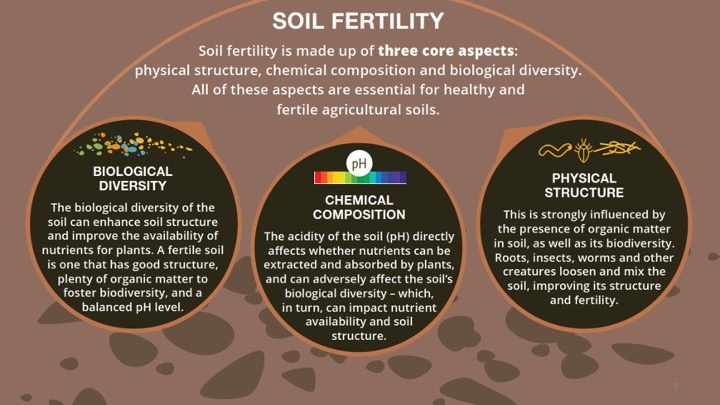
Organic-based fertilisers can play an important role in promoting and protecting soil health by benefiting the three core aspects of soil fertility – biological diversity, chemical composition, and physical structure. The European Commission, in their proposal for the Soil Monitoring Law, defines soil health as “the physical, chemical and biological condition of the soil determining its capacity to function as a vital living system and to provide ecosystem services”.
The ‘C’ in OrganiC stands for ‘carbon’
Organic-based fertilisers – organic fertilisers, organo-mineral fertilisers, organic soil improvers and fertilisers incorporating components derived from organic materials – all contain carbon, which allows them to play a vital role in protecting and promoting soil health.
All organic-based fertilisers improve the biodiversity of soils by providing them with organic matter:
Organic-based fertilisers are rich in organic matter that enhances the biological activity of soils, thereby also improving and sustaining their biodiversity. In doing so, organic-based fertilisers help to perform a vital ecological service. Soil is the medium that sustains a wide range of beneficial organisms – such as essential bacteria, fungi and earthworms, among others. Without soil biodiversity, both agricultural productivity and the well-being of the wider biosphere would suffer.
Organic matter includes any plant or animal material that returns to the soil and goes through the decomposition process. Organic-based fertilisers are a primary source of carbon, which gives energy and nutrients to soil organisms. This supports soil functionality, by improving the activity of microorganisms in the soil, and it can enhance biodiversity. Increasing soil organic carbon content and carbon sequestration has dual benefits as it also contributes to lowering CO2 emissions in the atmosphere, thus allowing soils to help mitigate climate change. Improving soil biodiversity is an important step in boosting soil health and biodiversity and mitigating climate change. This is recognised by the EU’s own Soil Strategy, and the importance of biodiversity is outlined in their Biodiversity Strategy and at the global level with the Kunming-Montreal Global Biodiversity Framework, which was adopted at COP15 in 2022.
Organic-based fertilisers improve the chemical composition of soils
Organic-based fertilisers help improve the soil’s capacity to store and supply essential nutrients such as nitrogen, phosphorus, potassium, calcium and magnesium. Organic-based fertilisers also allow the soil to cope with changes to soil acidity, and increasing organic matter in soils helps soil minerals decompose faster. While all organic fertilisers provide soil organic matter, refined organic-based fertilisers deliver a greater concentration of organic matter and nutrients along with more than just organic matter, such as greater safety from pathogens and contaminants and traceability of components.
Organic-based fertilisers can reduce nutrient losses
Nutrient loss and leaching are important concerns for farmers, landowners, and policymakers. Adding more nutrients than crops require can cause leaching and pose problems for the planet; organic-based fertilisers can contribute to better resource-use efficiency by reducing soil erosion, increasing efficiency and uptake and bringing recycled nutrients back into the cycle as fertilising products. Organic-based fertilisers are also developed using various by-products from a range of industries, transforming them into new products and re-using the nutrients from them rather than simply discarding them, making them an excellent example of the circular economy in action!