
Ensuring food security, as well as making farming and agricultural production more sustainable, is an important part of a greener, more competitive, and growing economy in Europe. The organic-based fertiliser (OBF) industry can play a role in helping to achieve this vision with our innovative products, which, through their materials, the beneficial natural processes they generate, and the ways in which they are produced, contribute to the sustainable, resource-efficient and low-carbon economy that the EU is committed to building.
Organic-based fertilisers have a long history in European agriculture. New, innovative products continue to be developed by enterprising agronomists dedicated to a food system that respects the environment. Organic-based fertiliser producers can be found across EU Member States and beyond from Italy, Spain, France, the UK, Finland and more. Recent progress in innovation, policy support at the EU level, a focus on strategic autonomy and a greater push for the creation of a circular economy has propelled the organic-based fertiliser industry forward to a new stage of development. The organic-based fertiliser industry is ready to play a vital role in the creation of a sustainable circular system of agriculture and in ensuring food security in Europe.
How organic-based fertilisers contribute to food security.
Our agricultural sector is undergoing many different changes in a time of increased challenges for farmers. From climate change to supply shocks to geopolitical tensions and war; farmers, policymakers, and industry need to adapt to ensure continued food security and a fair income for farmers and others in the sector. Organic-based fertilisers are one tool that farmers can use to combat these challenges and ensure they are producing food in a sustainable way while also guaranteeing food security. ECOFI, as a recognised trusted stakeholder by the European Commission, brings organic-based fertiliser producers together and works to promote the role organic-based fertilisers can play in combating these challenges and ensuring a progressive policy system and enabling regulatory framework for OBF solutions.
- Feeding a global population that is projected to reach at least 9 billion by 2050 will require yield increases and enhanced crop quality. Organic-based fertilisers enhance the quality attributes of produce as well as yield, thereby contributing to both the food quality and security we need.
- Organic-based fertilisers have the potential to make a significant contribution to the development of a low-carbon economy, which is one of the key targets of the EU’s growth strategy. Through their organic matter content, organic-based fertilisers help not only to transfer atmospheric carbon dioxide into the soil, but also impede its emission back into the atmosphere. The technology, therefore, plays a valuable role in soil carbon sequestration, which is a natural, cost-effective, and environmentally friendly way to offset emissions from fossil fuel combustion. As a result, beyond the obvious benefits they bring to agronomic productivity, organic-based fertilisers can help mitigate the effects of climate change.
- Organic-based fertilisers help improve soil health by maintaining or increasing the soil’s organic matter content over the long term. This will become increasingly important in Mediterranean growing regions, where the organic matter in soils is particularly low. Enhancing organic matter also enables the healthier soil to retain water more effectively, better resist erosion, and reduce losses through leaching.
- By minimising leaching, organic-based fertilisers reduce the environmental impacts of farming and safeguard surrounding ecosystems. Organic-based fertilisers are rich sources of organic carbon, which enhances fertiliser efficiency through an intelligent, slow release of nutrients like nitrogen and phosphorus. This also means a higher return on investment for farmers and better use of the natural raw materials from which many organic-based fertilisers are derived.
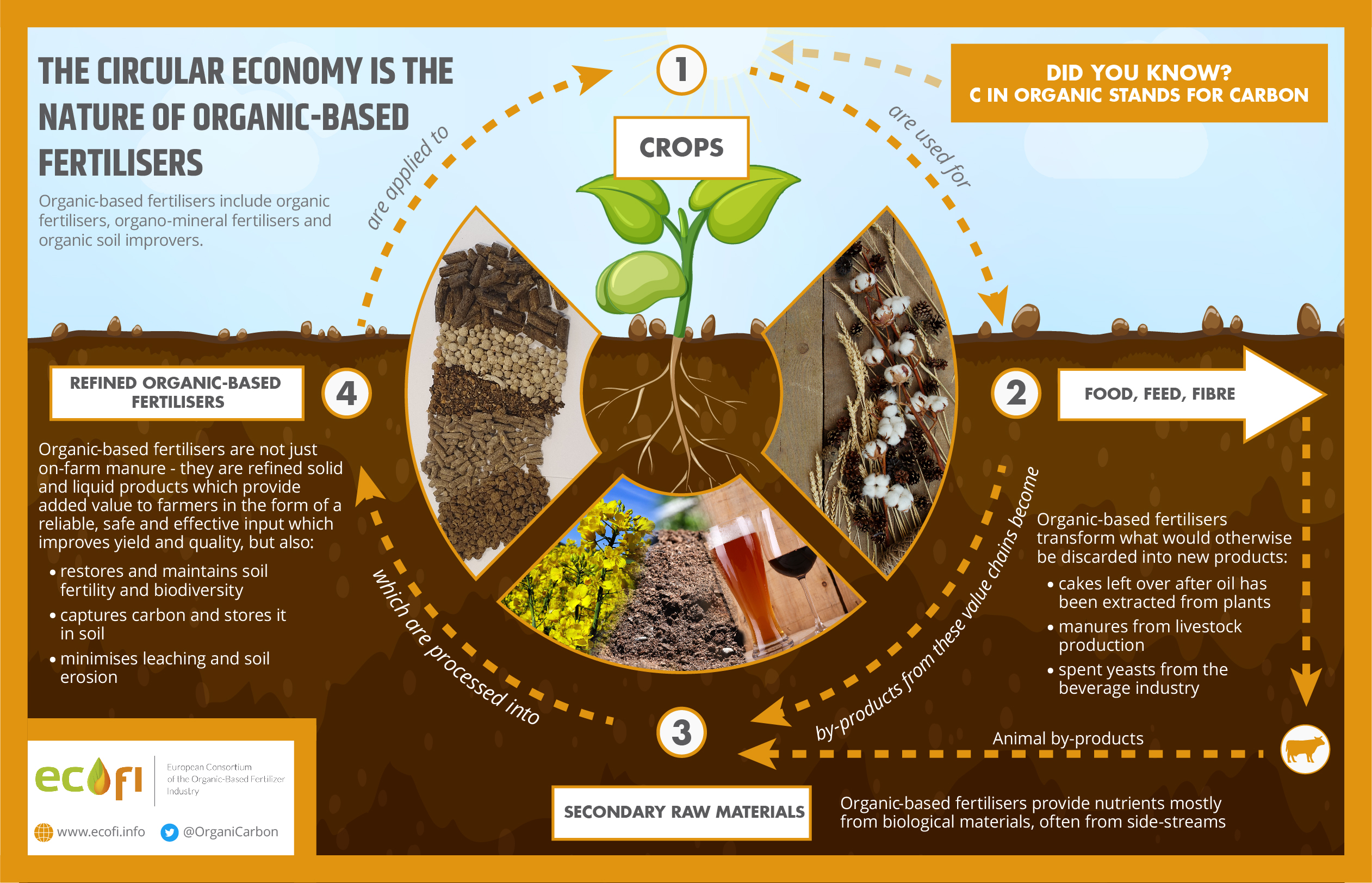
The added value of refined organic-based fertilisers versus on-farm sources:
Organic-based fertilisers help farmers when on-farm sources of nutrients from manures/composts are insufficient while also guaranteeing consistency and predictable quality as well as the traceability of components and the safety of the product from pathogens and contaminants, giving benefits and peace of mind to farmers. Organic-based fertilisers also help provide added value in agricultural contexts where low soil carbon constrains the uptake of mineral nutrients.
How organic-based fertilisers boost farmer incomes:
Organic-based fertilisers improve farmer incomes by helping farmers nurture sustainably fertilised soil that enables them to grow abundant, high-quality crops. Improved crop quality not only enables farmers to secure higher prices for their produce but also prolongs crop conservation, which gives farmers more time to choose the best moment to sell their crops at advantageous prices.