
Organic-based fertilisers (OBFs) include organic fertilisers, organo-mineral fertilisers, organic soil improvers and fertilisers incorporating components derived from organic materials. Organic-based fertilisers are one of the innovative green technologies driving the sustainable development that Europe needs today.
ECOFI defines these product categories as follows:
- Organic fertiliser: a fertiliser whose main function is to provide nutrients under organic forms from organic materials of plant and/or animal origin.
- Organo-mineral fertiliser: a complex fertiliser obtained by industrial co-formulation of one or more inorganic fertilisers with one or more organic fertilisers and/or organic soil improvers into solid forms (with the exception of dry mixes) or liquids.
- Organic soil improver: a soil improver containing carbonaceous materials of plant and/or animal origin, whose main function is to maintain or increase the soil organic matter content.
- Fertilisers incorporating components derived from organic materials.
The ‘C’ in OrganiC stands for ‘carbon’
Organic-based fertilisers provide soil organic matter and carbon which benefits soil health and biodiversity.
The organic-based fertiliser as an innovative industry in the circular economy
The organic-based fertiliser industry is part of a research-based, knowledge-intensive, and innovation-driven sector that is pioneering solutions to challenges throughout the value chain in agriculture, food and nutrition.
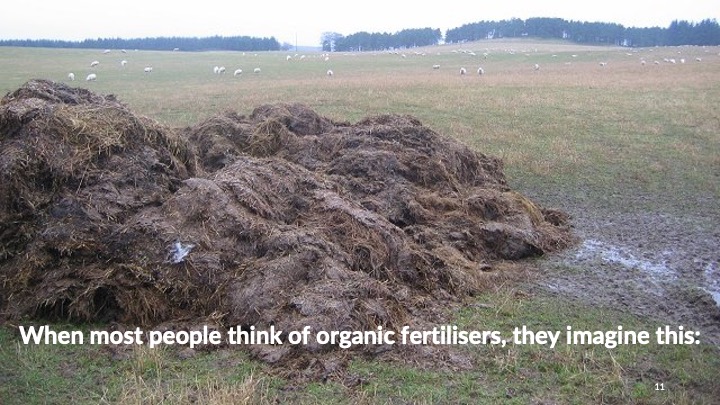
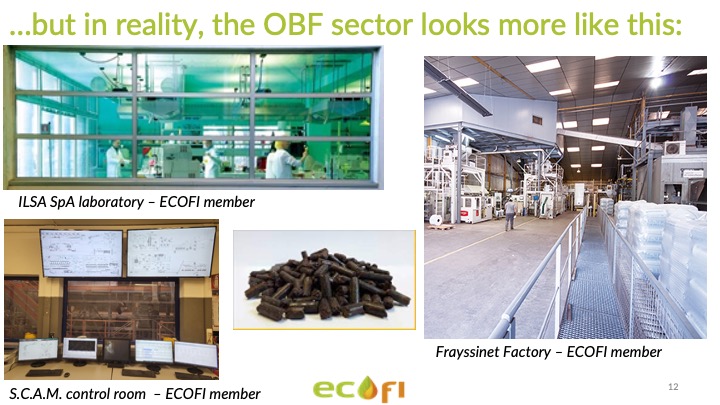
The development of organic-based fertilisers is rooted in both an environmentally respectful and deeply scientific approach to plant nutrition and the soil “food web” as a whole. Our sector conducts exploratory research to develop highly innovative formulations and production processes that nurture not only plants and soils, but also the emerging green technologies that are the engines of sustainable development. Organic-based fertilisers are an innovative and sustainable form of plant nutrition that can be used in conventional, regenerative and organic farming*!
Many of the components of organic-based fertilisers are derived from sustainably sourced plant and/or animal by-products which would otherwise be destined for waste streams. The added value of these materials in the production of organic-based fertilisers is one of the key innovations that the sector contributes to the agricultural economy.
Many of the components of organic-based fertilisers are derived from responsibly sourced plant and/or animal by-products, many of which would otherwise be destined for undesirable waste streams, such as landfills. Organic-based fertilisers offer farmers scientifically advanced tools that are essentially derived from nature, thus enabling them to farm in ways that are both economically viable and environmentally sustainable.
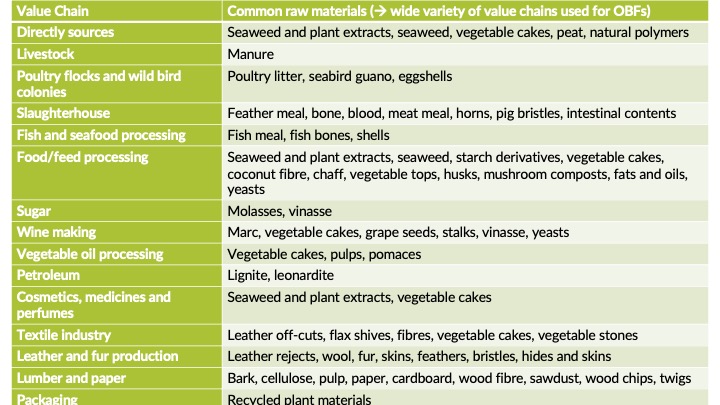
Examples of the materials used in organic-based fertilisers include:
Organic-based fertilisers need policy support to better support farmers and contribute to European soil health:
To ensure organic-based fertilisers help us achieve healthy soils in the EU, farmers need a supportive regulatory and policy framework in which to operate.
This regulatory and policy framework needs to:
- Enable the placement of OBFs on the EU Single Market;
- Foster innovation within the marketplace;
- Incentivise, advise, educate and train farmers and other users on the benefits of OBFs for soil health and how to ensure their effective use.
Organic-based fertilisers in the Fertilising Products Regulation
In 2019, the EU passed the Fertilising Products Regulation, which includes rules for organic-based fertilisers. ECOFI worked hard for our members to ensure the regulation worked to support the organic-based fertiliser industry. The inclusion of organic-based fertilisers in the Fertilising Products Regulation (FPR) should help grow the market thanks to the harmonisation of rules governing their access to market across the EU. The FPR helps guarantee high levels of safety and environmental protection thanks to the new common requirements for quality, safety and labelling, which is beneficial to farmers and consumers. This regulation aims to help facilitate cross-border trade for organic-based fertiliser producers, and it will help empower European farmers to make informed choices about plant nutrition management.
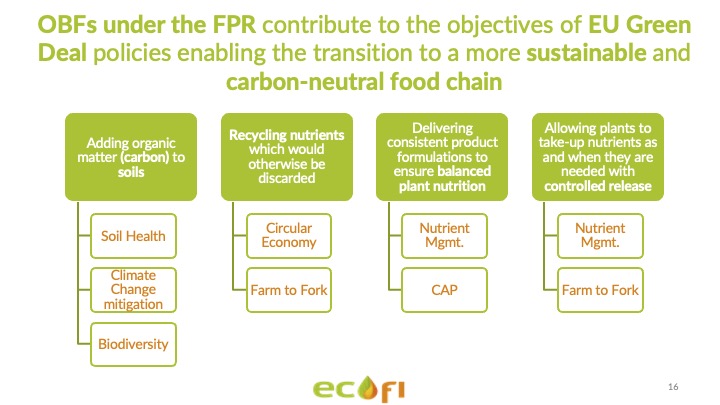
Organic-based fertilisers under the Fertilising Products Regulation contribute to the objectives of the EU Green Deal policies, enabling the transition to a more sustainable and carbon-neutral food chain.
However, challenges for organic-based fertilisers in the Fertilising Products Regulation continue to stand in the way of innovation and the success of the organic-based fertiliser industry.
Key component materials for organic-based fertilisers are still missing in the Fertilising Products Regulation and the plans to add them are currently not fit for purpose.
- Lack of Animal By-Products
- Delayed harmonised standards
- Missing Materials, including solvent-treated oilseed cakes.
Are you a European producer of organic fertilisers, organo-mineral fertilisers, organic soil improvers or fertilisers incorporating components derived from organic materials whose production ensures the upstream traceability and the origin of raw material components? Are you interested in helping shape the future of EU fertilising regulation and policy for the benefit of organic-based fertilisers? If so, joining ECOFI will give you a platform to connect with other producers in Europe and work within an organisation that is recognised and trusted by the European Commission and give you access to regulatory and advocacy support to help you grow your business!
If you are interested, you can contact Jessica Fitch at jessica@prospero.ag to discuss membership and what it can do for you!